“The essence of this experiment is to let everything remain in flux — to let the artist become a participant, ordinary people become creators, the audience become curators. Social sculpture naturally occurs through interaction. You are Lao Mu.”
One September Afternoon
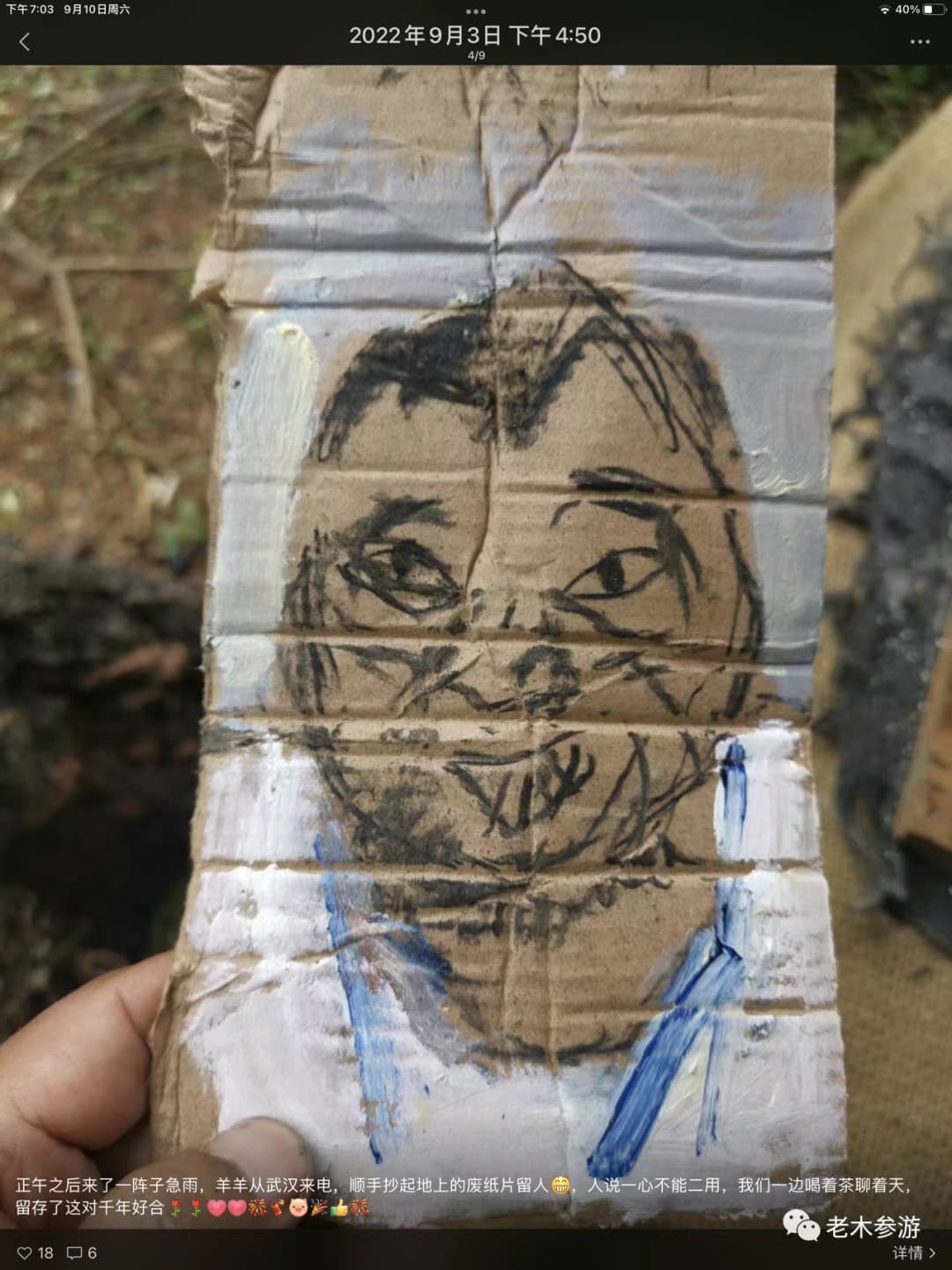
On the afternoon of September 3, 2022, Lao Mu was resting in his rural studio — drinking tea — when his old friends Yang Yang and Huang Dan called from Wuhan via video chat. Chatting, he reached down and grabbed a scrap of cardboard from the floor, and with a piece of charcoal from the tea fire, drew Yang Yang's portrait on the spot. Then he picked up a small wooden tea board and drew the couple together.
After a moment, they laughed and said: 'Why not just do this online?'
From that afternoon, 五百罗汉在线 — Five Hundred Arhats Online — was born. A thousand years of good fortune, stored in a chance drawing on found cardboard.
But the project had an earlier prehistory. In August 2022, the project had been planned for a public debut at the Fanghua Li Modern Art Market in Kunming — an outdoor artisans' gathering at the Fanghua Li Railway Courtyard. Twice the preparation was complete; twice a COVID outbreak in Kunming forced postponement. In response, Lao Mu wrote in his WeChat signature: 'COVID is not fearsome. What is fearsome is that we do not act.'
Eventually, unable to leave the house, he decided to take it online. He reasoned: 'They say the most serious problem on earth right now is depression — every second, someone commits suicide. Since I can't go out, I might as well just chat with people online, talk, paint along the way, make some records. Who knows — maybe we will accidentally cure some depression.' He picked up a battered old Huawei P20 and a second-hand Apple SE, hands and feet fumbling, and launched Five Hundred Arhats Online.
Contemporary Arhats

In Buddhist tradition, the arhat is one who has attained enlightenment — a being of extraordinary realisation, distinct in face and nature from all others. In Chinese folk art and temple culture, the 五百罗汉 — Five Hundred Arhats — appear as a gallery of humanity in its full range: the fierce, the serene, the laughing, the sorrowful, every face a portrait of a particular soul.
Lao Mu's project inherits this tradition and inverts it. His contemporary arhats are not idealized figures in stone. They are ordinary people — friends, strangers, those he meets across distances, those who sit with him for tea and conversation while he draws. The medium shifts with the moment: charcoal on found cardboard, oil paint on canvas, pigment on a fragment of stone. The materials are whatever is at hand.
The project ran as live video-call portrait sessions during the COVID pandemic — when physical presence was impossible, and a face on a screen, drawn in real time, became a form of profound human contact.
Portraits of the Contemporary

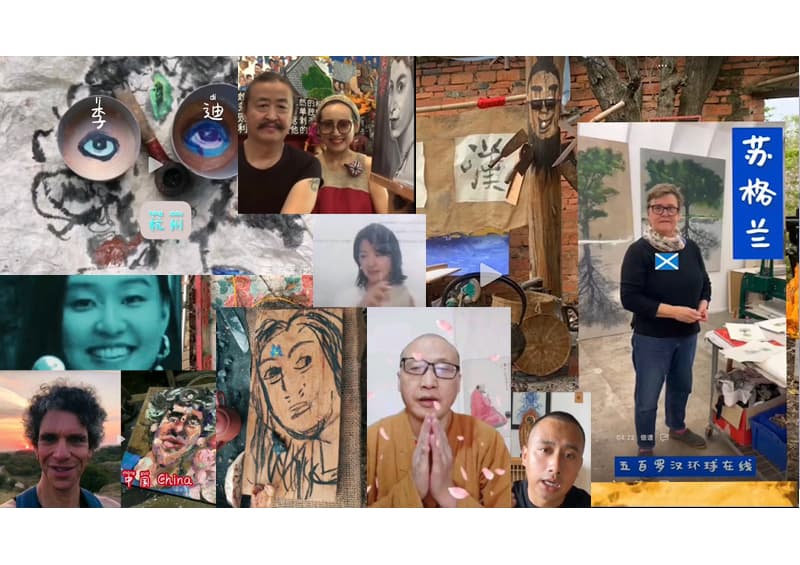
The project accumulated portraits of people drawn from across the world, each with a story that had brought them into Lao Mu's orbit. A selection:
No. 1 & 2 — Yang Yang and Huang Dan, sculptors and educators, Wuhan. Yang Yang was the very first subject, drawn on found cardboard during that September tea call. Lao Mu: 'The funniest thing is that the first time Li Jiang took me to their shop, I stared at Yang Yang's face for a very long time, then told him I don't like you — and from then on we became very good friends.' The couple now teaches in Wuhan, conducting children's education through art.
No. 3 — Benjamin, Dean of the Faculty of Law at Leiden University, the Netherlands. A Dutch-Jewish man and long-time friend of Lao Mu, he had recently recovered from COVID twice while also carrying another illness — and remained entirely unaffected. He runs thirty kilometres on weekends and plays piano. 'I thought in this world only I play piano the worst,' Lao Mu wrote, 'and then it turned out he plays better.'
No. 4 — Tung Tung (童童), founder of art companies, Hong Kong. Born in Hong Kong and raised alone in England, she graduated from Central Saint Martins in ceramics. Lao Mu and she were both in Jingdezhen's Sanbao district when she was eighteen — she was the first woman to appear during Lao Mu's 'three-year seclusion' project. They played together every day that summer. One day she drew hundreds of stars on his hand. 'Because of that anti-human experimental project from back then,' Lao Mu wrote, 'there would be this online conversation ten years later.'
No. 5 — A spiritual medium from Hainan. A near-death experience after a trip to India made her, in her own account, a crosser of worlds and a messenger. Lao Mu: 'Over the years I have seen all kinds of masters, folk shamans, people with extraordinary powers — yet in the end one always discovers, behind all the magnificent holy garments, the ugly human truth. The sudden appearance of Blue Lotus showed me new possibilities.'
No. 6 — An artist from Jingdezhen living and creating in Belgium. Lao Mu drew her on the tablecloth of her studio — his left hand holding a phone for video recording, his right holding a brush. 'If art is truly in the service of the people, you must first ask what the people want. Practicality is beauty: a traditional easel painting can become a tablecloth, or part of a tent.'
No. 7 & 8 — Painter Zhu Yongpei and his wife, Anqing. Lao Mu drew him on a small wooden water polo ball he had bought in Lijiang twenty years before and never used. 'Old Zhu rarely speaks, buried in his studio painting porcelain panels. His wife summons us to the table at mealtimes, and her cooking is better than any restaurant I have eaten at in Jingdezhen.' Once they rode motorcycles together from Jingdezhen to Anhui to find xuan paper — hundreds of kilometres of continuous heavy rain. 'His underpants were never dry the whole journey.'
No. 9 — Li Di, sculptor-turned-tea-seller, Hangzhou. Once a sculptor who grew weary of Beijing's art world, he now drinks tea, sells tea, and writes calligraphy. His equipment, his clothes, his phone are always the finest and most fashionable. Lao Mu drew him using the tea tin and tea-wrapping paper Li Di had sent as a gift. 'Letting go of art, picking up the self. Li Di is actually a super pure and simple person, who joyfully helps the friends around him in his own unique way.'
No. 10 — Monk Yongwu (永悟师父). They met in Myanmar ten years before the project, during Lao Mu's first short ordination retreat — when Yongwu had already long been ordained. 'Time is what tests truth. 忽有故人心上过,回首山河已是秋。 — Suddenly a thought of an old friend passes through the heart; I look back and rivers and mountains have already turned to autumn.'
No. 11 — 'Lao Jiang' (老姜 / Big Tomato), founder of the Modern Market, Kunming. The friend who had originally invited Lao Mu to show the Five Hundred Arhats at the Fanghua Li market. Lao Mu: 'Apart from me — who can live without making money — he is the great god who can make money without working.'
No. 12 — Doufu Brother (豆腐兄), Wenzhou. Formerly the owner of two well-known travellers' guesthouses in Yunnan's Xishuangbanna, he now lives freely on a small island in the Pacific, fishing. 'He is one of the only people I know who can both communicate with spirits and move through the human world with the ease of an arhat. His stories all come from his dreams, which are entangled with his reality. I have been reading his stories for many years and never tire of them.'
Into the World
In October 2022, the project moved off-screen. The organiser Zhang Ying and her collaborators drove from the city to Lao Mu's rural studio, inviting him to bring the Five Hundred Arhats to Kafka Café in Kunming.
Lao Mu had known Zhang Ying for over a decade. When he had first walked into Kafka Café — on Wenlin Street in the old city — its walls were covered entirely in hand-drawn books: thousands and thousands of books, all drawn by the female owner herself. 'I was amazed. Who would be willing to draw ten thousand books so patiently? I asked, and found it was the owner herself. From then on we became friends.' Zhang Ying had been a military officer, then a senior bank executive; she opened Kafka Café to pursue the life she wanted. The café's cats were always fat and large, sleeping at the entrance. Lao Mu had been dropping by for years — ordering a cake, having coffee.
What unfolded in October was not a conventional exhibition. Participants became creators. Viewers became interviewers, photographers, writers, live-streamers. Someone was in charge of conversation; someone was making documentary footage; someone was writing an essay about what they were watching. The boundary between audience and artist dissolved.
'This experiment,' Lao Mu wrote, 'was the most effortless event I have ever run. Social sculpture occurred naturally through interaction. You are Lao Mu.'