Conceptual Artist · Naxi
About
March 23, 1971 · Kunming, Yunnan, China · Lijiang, Yunnan / Chiang Mai, Thailand
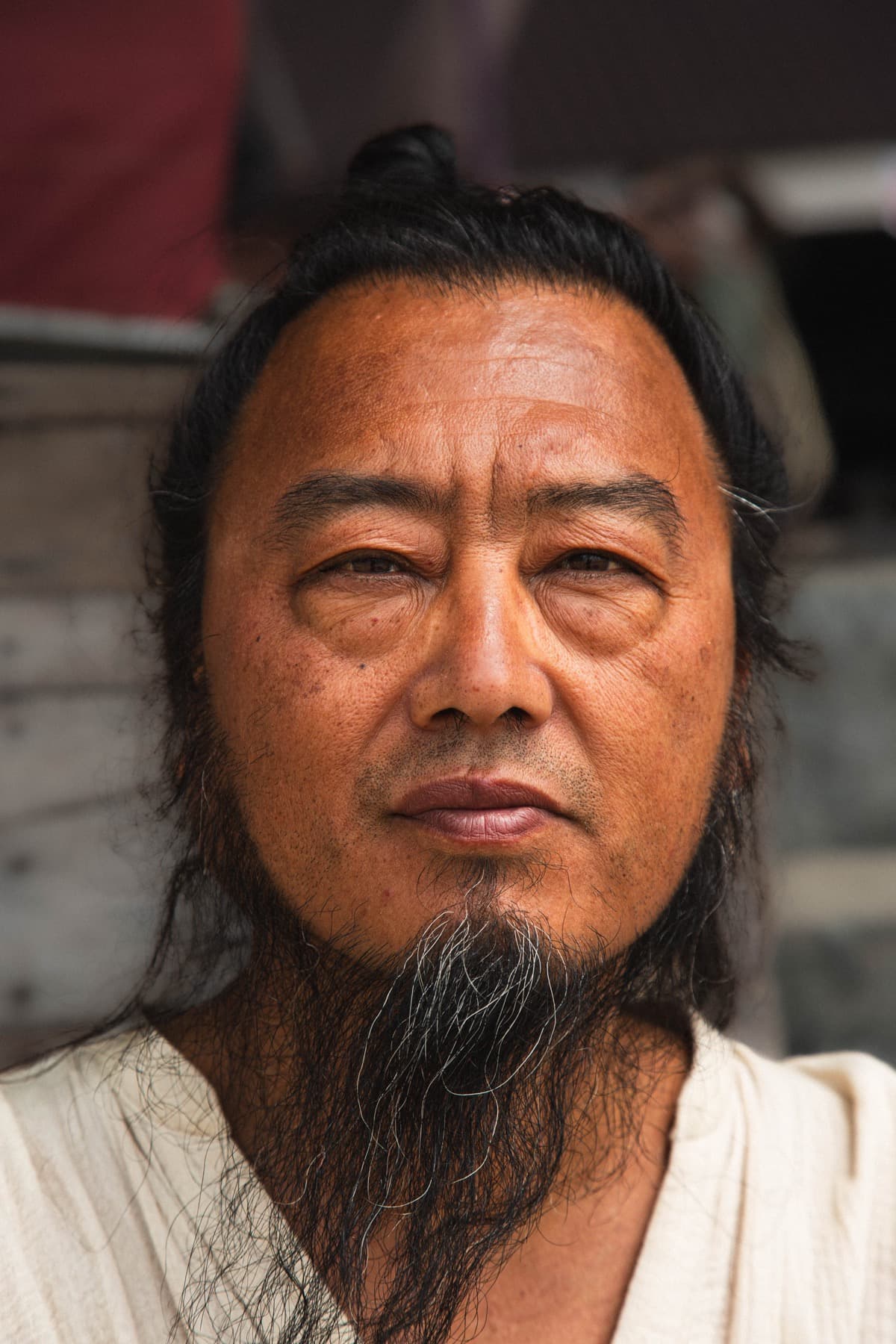
Artist Statement
As a descendant of the Naxi Lijiang Mu chieftain lineage and heir to the horse-caravan traditions of the Ancient Tea Horse Road, my artistic practice is rooted in the cosmological framework of the Dongba creation epic Chongbantu (The Genesis), which I have transformed into an ontological action within the context of contemporary experimental art. In this narrative, Chongrenli'en (Coq-heel-eeq), the sole survivor of the primordial flood, undertakes a migration that is not merely geographical displacement but a unidirectional expedition from ontological ruins toward civilizational genesis—a creation paradigm that takes death as its point of departure. In 1986, at the critical threshold of an existential experience by the shores of Kunming's Green Lake, I encountered an isomorphic choice: facing the abyss of nothingness, retreat to the realm of the gods, or bear the burden of creation through the flesh. This confirmed for me the fundamental mission of experimental art: to use the limit-experience of the individual to probe the boundaries of existence for humanity, carving out a space of shared habitation within the void. Art is thereby no longer a tool of aesthetic expression, but an ontological event through which the world is regenerated; life is no longer objectified material, but the contemporary manifestation of naq in Dongba ritual—the surrogate that assumes catastrophe, transforms life and death, and maintains cosmic order.
For nearly four decades, I have practiced under six artistic names—Zhuangzi (Pile), Lao Mu, Lijiang Farmer (Farmermu), Xian Mu Concept, Mengchunsheng, and Heiqiu'en—constituting a Deleuzian topology of "becoming" and a nomadic subjectivity that resists fixation. Each identity is a ritual sacrifice and ontological renewal of the preceding self, a reverse operation against what Agamben terms "bare life." Through the surrogate logic of naq, individual life is transformed into an ethical medium that assumes catastrophe and mediates between life and death. In this sense, my experimental art transcends the traditional subject-object dichotomy: the body is no longer an objectified tool of critique, but a subjectified technology of life; creation is no longer the manufacture of products, but the weaving of relations and the catalysis of community. From the Oslo National Academy of the Arts to the Rijksakademie residency, from the Theravada Buddhist sangha in Myanmar to five years of seclusion in Jingdezhen (2014–2019), from Lijiang Studio to the thatched hermitages of Zhongnan Mountain, my migratory trajectory constitutes an inter-civilizational spiritual geography and epistemological practice. In an era when globalization engenders cultural homogenization, this mode of creation—taking the Naxi cosmology (the interactive triad of gods, humans, and ghosts) as its underlying code and global-local experience as its operational interface—offers humanity a cognitive model that transcends the East-West binary. It does not seek the political correctness of cultural identity, but reconstructs a shareable spiritual syntax at the intersection of heterogeneous civilizations. This is the deepest contribution of experimental art to human epistemology: proving that difference is not the root of conflict, but the condition of creation.
The "Decade of Public Silence" from 2013 to 2023 constituted a radical suspension of the archival politics, discursive production, and commercial regimes of contemporary art. As society sank into the tyranny of visibility under informational capitalism, I used silence to demonstrate that existence precedes representation, and that authentic time cannot be co-opted. This "anti-archivality" was not a passive withdrawal from the world, but a strategy of writing a wordless Chongbantu—preserving for humanity a paradigm of resistance that cannot be consumed. Concurrently, the implementation of "Project Zhuangzi" (later "Project Zhuangzi/Zhuangzi Plan") and the construction of a rural art community extended Beuys's concept of "social sculpture" into an Eastern context—art is no longer merely an object within the museum, but a practical field for reshaping ways of life and reconstructing the ethics of the land.
From the no-budget limit-survival of The Twenty Days Project, to the reconstruction of civilizational meridians through tea in Tea Alms, to the ethical assumption of responsibility for the life-dignity of pandemic orphans in Our Children, my projects persistently ask: Can art serve as an antidote for humanity in the age of nihilism? I believe the ultimate contribution of experimental art lies not in formal innovation, but in providing an alternative mode of existence—a capacity to continue sowing seeds amid ruins, armed with the courage of being-toward-death, the wisdom of inter-civilizational dialogue, and an unconditional ethics of gift-giving.
Life is art. Living is the practice ground. The flood has never ended, and experimental art is the craft by which humanity rebuilds its ark amidst the floodwaters.
Names & Alter-egos
Education
Exhibitions
25 · 1996 — 2026
The Record
Frequently Asked
- Who is Mu Yu Ming?
- Mu Yu Ming (木玉明, b. 1971 in Kunming, Yunnan) is a Naxi Chinese contemporary conceptual artist whose practice spans oil painting, ink, performance, and social sculpture.
- What media does he work in?
- Oil painting, ink series, ceramics, photography, performance, and social sculpture — oil painting is one medium among several, not the whole practice.
- Where did he train?
- At the Central Academy of Art & Design, Beijing (1993–1994); the Oslo National Academy of the Arts (Kunsthøgskolen i Oslo), where he earned a BFA in Experimental Art (1996–2000); and as an artist-in-residence at the Rijksakademie, Amsterdam (2005–2006).
- Where is he based?
- Between Lijiang, Yunnan (China) and Chiang Mai, Thailand.
- What does his work explore?
- Buddhist practice and meditation, Naxi heritage and Dongba script, tea as social sculpture, mountain travel, and the relationship between art and everyday life.