The Full Essay
Project Essay
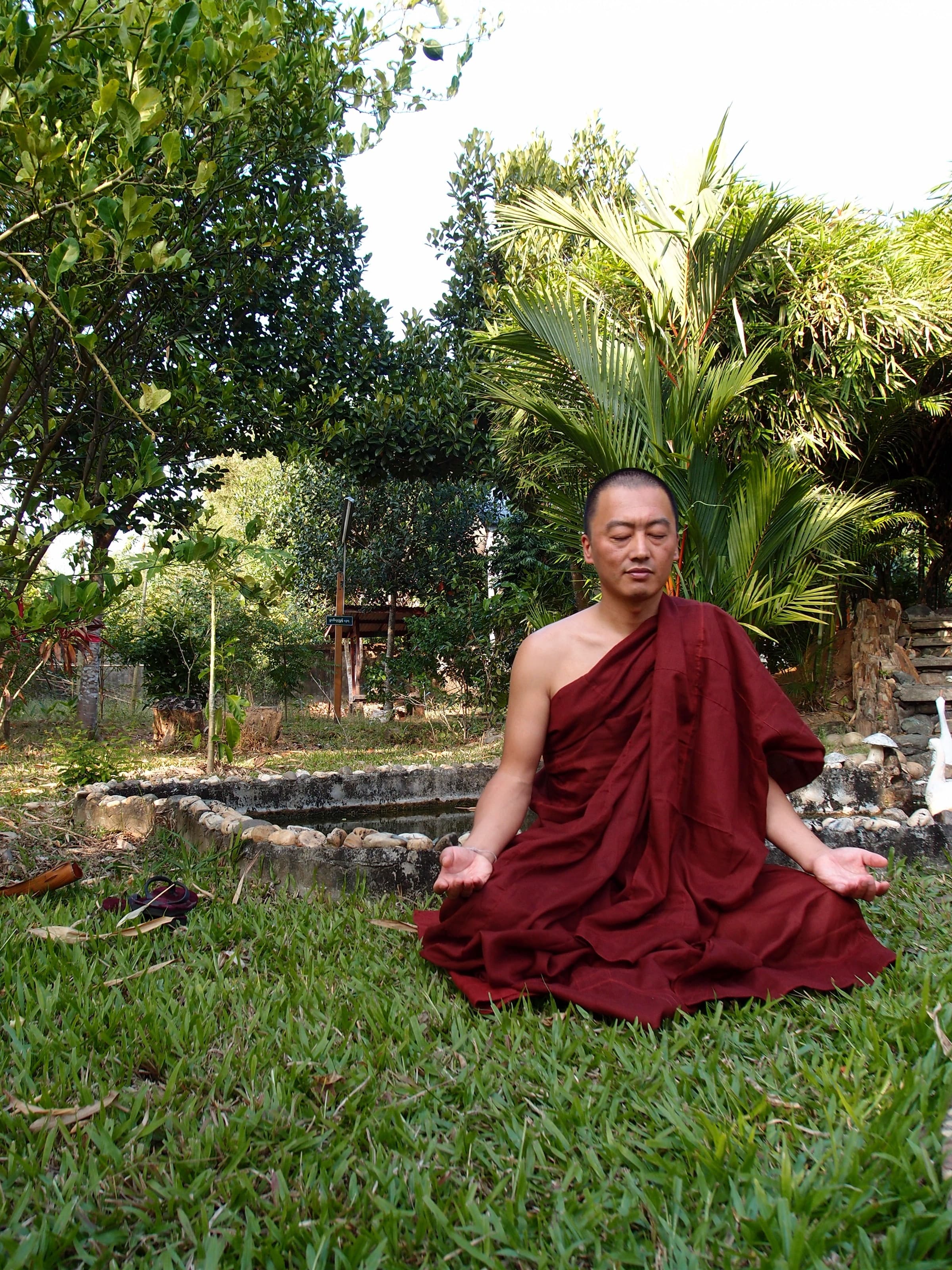
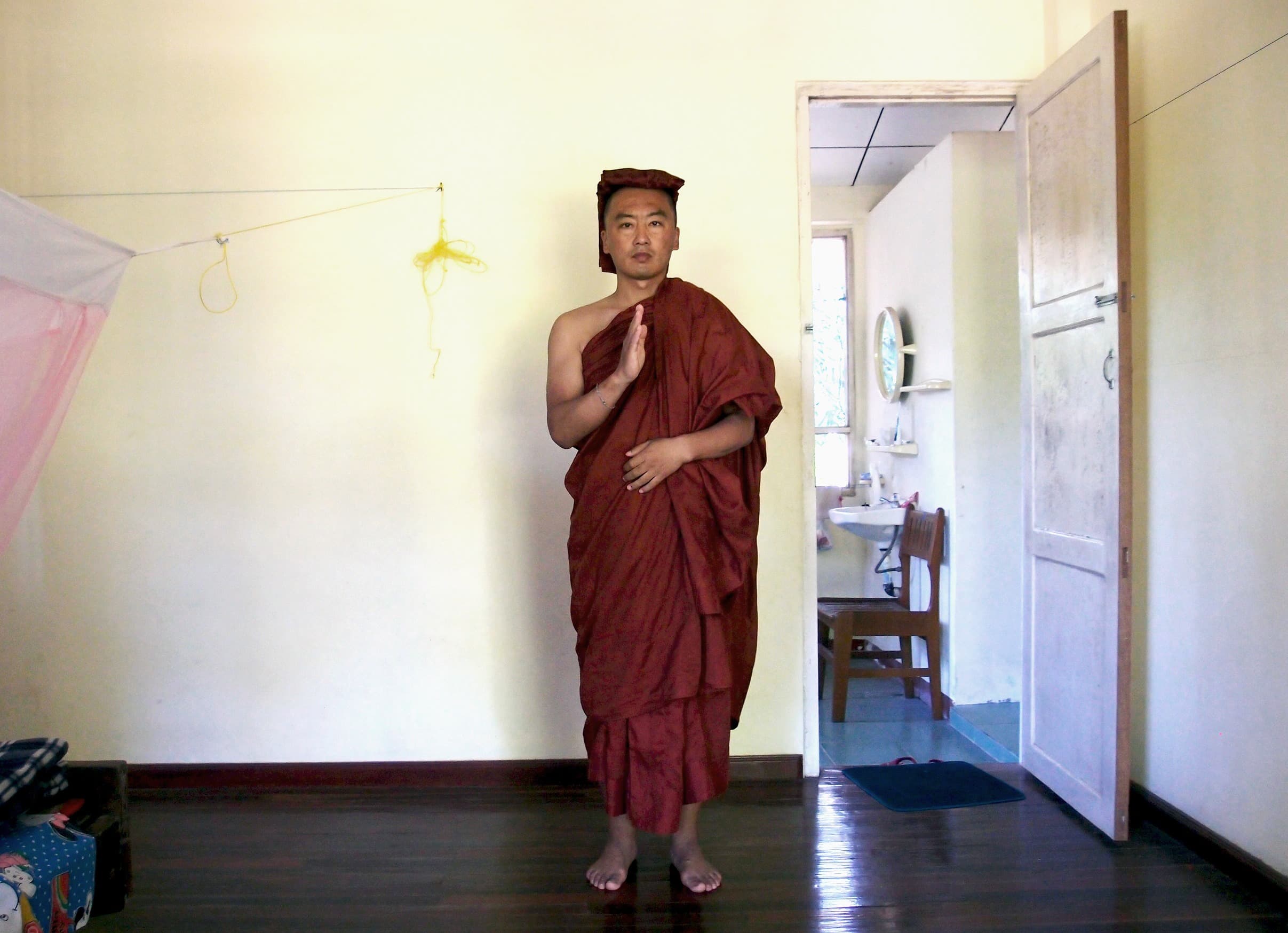
Short-term monastic ordination in Myanmar — wearing the crimson kāṣāya, undertaking meditative practice in tropical jungle and simple monks' quarters. This was not a religious conversion but a carefully designed “going under” — infiltrating the religious institution in flesh, returning the experience to artistic creation, ultimately returning to the artist's identity without losing the original aspiration. As he himself put it: “I was like an undercover agent — I went in, but I never forgot who I am.”
The deeper motive for this ordination traces back to the artist's experience of life-and-death at age fifteen. In 1986, while walking by Kunming's Cuihu Lake, Lao Mu saw through the dust of the world and attempted suicide at Xishan; in that instant he perceived multi-dimensional space and tunnels of space-time, the world's brightness suddenly multiplying tenfold, hearing sounds from ten kilometres away. This “miracle” was not a religious revelation but an extreme experience of ontological rupture — when the individual confronts the void, the single dimension of daily reality suddenly collapses, exposing the folds of manifold possibility. Heidegger's “Being-toward-death” here takes concrete form as a perceptual revolution: death is not the end but the opening-up of being. Lao Mu's reason for choosing to stay was not faith but painting — “whenever I was sad or unhappy, I'd just paint a picture, and that was enough”. Art became the anchor of being, replacing religion's promise of salvation. More than twenty years later, his ordination in Myanmar was precisely an institutionalized religious practice that retraced and verified this original experience: if a monk had appeared in those mountains, if at that moment he had chosen ordination, how would the life have unfolded?
In Myanmar, Lao Mu followed the monastic precepts, undertook bodily discipline and meditation, and made the acquaintance of practitioners such as Yongwu Shixiong. The core methodology is to “kill one's original self, forget oneself, become that thing — and yet still remember”. This is not Chan Buddhism's Eastern sudden-awakening of “no-self” but a practice of Derridean “différance” — identity slides in continuous difference and deferral, never arriving at a fixed signified. Lao Mu's “undercover” posture is precisely a deconstruction of the concept of “authenticity”: there is no core self prior to performance; only in the infinite oscillation between role and counter-role can the subject be generated. The kāṣāya is at once a dharma instrument and a costume; meditation is at once practice and performance. This ontological indeterminacy constitutes the philosophical bedrock of his artistic method.
The “Three Years Retreat” project begun in 2017 [sic: 2014] directly continues the ordination experience, forming a three-fold dialectical structure: Year One “He” — the practitioner returned from ordination, the saintly figure in the kāṣāya; Year Two “Lao Mu and Meng Chunsheng” — the splitting and doubling of the subject, the Naxi artist of reality and the artistic avatar / trans-dimensional traveller mirroring each other; Year Three “He / She” — the theatricalization of relations, the girlfriend wholly nude holding the artist's portrait, turning “he” into the possessed “Said”, or letting the relation itself become the work. The experiment is ultimately completed through bodily collapse (the 120 emergency call, half a year in a wheelchair). The little vegetable-market bicycle replaces the Buddha image as “the entire dharma instrument and tertiary retention” — the sanctification of the everyday object is precisely a radical reconstruction after the disappearance of Benjamin's “aura”: when the age of mechanical reproduction ended traditional art's cultic value, Lao Mu re-injects ritual radiance through bodily reproduction (ordination, retreat, wheelchair), yet deliberately preserves its abjection — the marketplace banality of the bicycle, the sick-state of the wheelchair, the impermanence of the kāṣāya — so that sacred and secular interpenetrate in the liminal space.
This transformation is not symbolic appropriation but is grounded in a “water-natured prior” affinity of life. Even before formal training, Lao Mu chose ink — “just because that thing felt close to my own taste, I liked that flavor, that quality”. Here it resonates with Merleau-Ponty's phenomenology of the body — cognition is not Cartesian mental computation but the primordial interweaving of body and world. The seepage, blurring, and uncontrollability of ink is precisely the materialized form of bodily perception. Likewise, ordination is not a rational choice but an awakening of past-life memory within the DNA chain, a mission conferred by the Creator. Lao Mu's experience of “miracle” thereby gains phenomenological legitimacy: it is not a supernatural hallucination but the extreme appearance of the body-world correlation, the brief laying-bare of the plenitude of being usually concealed by the everyday.
From his ordination in Myanmar to the 2025 CERN particle-collider project, Lao Mu has always been exploring the same ultimate inquiry: the cause of life, the source of the universe, the reduction of the Creator. This inquiry attains a dimension of technical philosophy within Bernard Stiegler's framework of “tertiary retention” — the experience of ordination, as memory, must be retained and transmitted through external technical apparatuses (kāṣāya, bicycle, handscroll, particle model), and these apparatuses simultaneously distort and generate the contents being retained. On returning home in 2013, his mother's grave illness opened the “Three Years Retreat”; in 2023, after his mother's death, he launched the “Tea Dāna” project, embodying the Buddhist spirit of dāna — recognizing the mutual dependence between individuals and helping people release attachment; in 2025, after his father's death, he created the fifty-metre raw-rice paper handscroll “Zongtong Temple”, forty-one days entering performance through action and recording the handscroll through text. Ordination is not the endpoint but the starting point of a sixteen-year continuing experiment of thought-and-body — from religion to art, from body to science, from individual to relation, from flight to facing.
Lao Mu criticizes the practice of treating performance art as an end in itself — “performance art is a giant trap dug for artists; art has harmed many artists”. He instead treats his entire life as an unbounded artwork: ordination is the work, returning to lay life is the work, the wheelchair is the work, the handscroll is the work. This stance forms a dialogue with Beuys's “social sculpture”, but Lao Mu emphasizes the particularity of the Chinese context — “the Chinese cultural background and post-WWII Germany are two completely different things”. When the individual is not yet perfected, how can he transform the world? Ordination is precisely the response to this fundamental dilemma through extreme self-perfection, while simultaneously revealing its paradox: to perfect the self is to acknowledge the imperfectibility of the self, just as “killing oneself” is the ultimate way of preserving oneself.
The PDF document positions the Myanmar ordination as “the antecedent of Lao Mu and Meng Chunsheng”, the starting point of “flight and facing, exploration and discovery, in the real and the abstract worlds”. The dialectic of “flight and facing” here must be understood within the context of Zhuangzi's philosophy: Free and Easy Wandering (xiaoyao you) is not passive world-renouncing but “being without dependence” (wu dai) — the absolute freedom that does not depend on external conditions. Lao Mu's naming of “Jiang Hu” (rivers and lakes) takes its meaning here: vast and boundless and yet within reach, in the human world and yet transcending it. Ordination is “flight” — fleeing toward the shelter of jungle, kāṣāya, and precepts; ordination is also “going-toward” — going toward the void, the body, the limits of relation. Ultimately, all experiments are set down — “the experiment was about enough, so I set it down; because of my experiment and the appearance of another point, I have to give up even from the very beginning of life” — this is not nihilistic abandonment but a strange fusion of Daoist “non-action” and Nietzschean “eternal recurrence”: within the repetition of the same day, within the declaration of “living within the same day”, the inquiry itself becomes the answer, the giving-up itself becomes the retention.