The Full Essay
Eyes Meeting on the Second Floor of the Glass Box
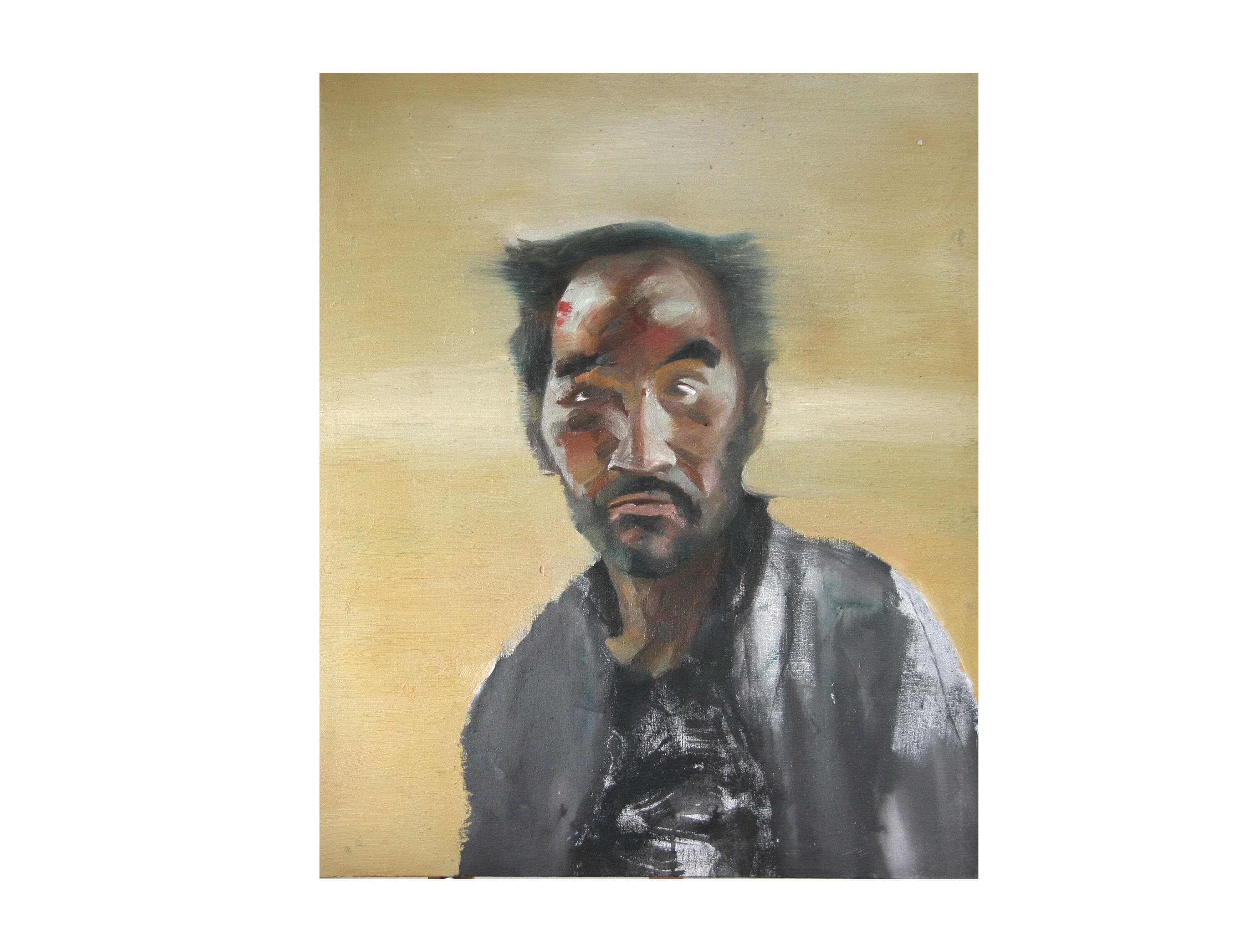
“My Fourth Uncle,” 2003, oil (mixed media of ink, oil paint, and water), Haidong Village, Lashihai, Lijiang.
In 2003, the artist returned from Europe and, on the unfinished second floor of the Lijiang Studio's Haidong exhibition hall — a glass box — beside the ancestral home in Haidong Village, Lashihai, Lijiang, met his fourth uncle. The two looked at each other face to face, gazing at one another. The artist spoke Kunming dialect and the Mandarin he had brought back from Europe; the fourth uncle spoke the Naxi vernacular; their languages did not connect, and only their gazes interwove. In the artist's heart burned an inexpressible joy, and also a feeling of tears welling up — having finally returned from Europe to the ground on which his ancestors grew, facing his own kin, the membrane of the bloodline was pierced in silence. Within half an hour, the artist completed this portrait.
Medium and Technique: An Aesthetics of Conflict between Ink and Oil
At the time there was only one box of oil paint, but no painting medium. The artist mixed ink into the oil paint, blended it with water, and improvised on the frame. The penetrability of ink and the covering power of oil paint conflicted with each other, the flow of water and the congealing of oil opposed each other, and by chance produced an unprecedented texture — neither the misty diffusion of traditional ink nor the heaviness of Western oil painting, but a direct collision of two civilizations on the canvas. This chance discovery became a methodology consistent throughout the artist's later creation: taking the conflict of ink and oil as a language, seeking a third path between East and West.
Composition and Space: The Dialectic of Transparency and Concealment
The portrait was created on the second floor of the glass box of the unfinished exhibition hall. The transparency of glass pursues the openness and permeability of modernity, while the fourth uncle's life was confined to the closure and invisibility of the land. The transparent architectural shell forms a sharp contrast with the fourth uncle's concealed talent and interrupted schooling. The artist gazed down upon (or level from a height at) the fourth uncle, while the fourth uncle was confined for life to the first floor of the land — the high-low dislocation of space intimates the different fate-trajectories of the family members: the vertical separation of the one who left and the one who stayed.
Expression and Gaze: The Core Paradox of Portraiture
The Western portrait tradition pursues “catching the soul,” while Chinese portraiture stresses “conveying the spirit in the likeness” (chuanshen xiezhao). This portrait of the fourth uncle, however, lies in the fault zone between the two: the fourth uncle's gaze is hollow — a lifetime of suffering and forbearance has exhausted the fluidity of expression; yet the interweaving of the artist's and the uncle's gazes is burning — the membrane of the bloodline is pierced in silence. Traditional portraits are mostly three-quarter or frontal, creating the “performativity” of being looked at; but this portrait is a level, “face-to-face” gaze — refusing the power relation of looking down or looking up; it is a family portrait, not a social portrait, a mutuality of gazing, not a one-directional scrutiny.
The Family's Only One Who Stayed
The grandfather had four children in all: the eldest is the artist's father, the second died of wrongful injustice during the Cultural Revolution, the third, a daughter, married into the He family, and the youngest is the fourth uncle. The fourth uncle was intelligent from childhood and excelled at study, but because the household needed a male to stay and care for the grandmother, he was forced to give up his schooling and was confined to Haidong for life. He is the family's only male who stayed on the land of Lashihai. When the father went toward Kunming, the second uncle toward Tsinghua and death, and the third aunt married into the He family, only the fourth uncle stayed in place, bearing the entire weight of the land.
A Lifetime of Suffering and Scars
The fourth uncle suffered every kind of worldly hardship; in his hollow gaze lie a lifetime of scars and forbearance. He is the silent witness, in modern society, of the descendants of the Mu chieftains, the last guardian of the Lashihai domain that the grandfather managed as former village head and caravan lead. The transparency of the glass box forms a sharp contrast with the fourth uncle's concealed life — the building was not yet finished, and the fourth uncle's life was never completed either.
From Absence to Presence
From the imaginative summoning of the soul in “My Grandfather” in 1988 to the real gaze of “My Fourth Uncle” on the second floor of the glass box in 2003, over fifteen years the artist completed the transformation from absence to presence. The fourth uncle's hollow gaze forms a dialogue with the grandfather's mysterious absence: one a ghost swallowed by history, the other a survivor imprisoned by the land. From then on, the artist visited the fourth uncle every time he returned home, this portrait being the hidden starting point of all his projects — reminding the artist: before going global, first complete a gaze of interwoven eyes with the silent one of the family; before writing art history, first stew a bowl of hot ham soup for the grandmother.