The Full Essay
Full Essay
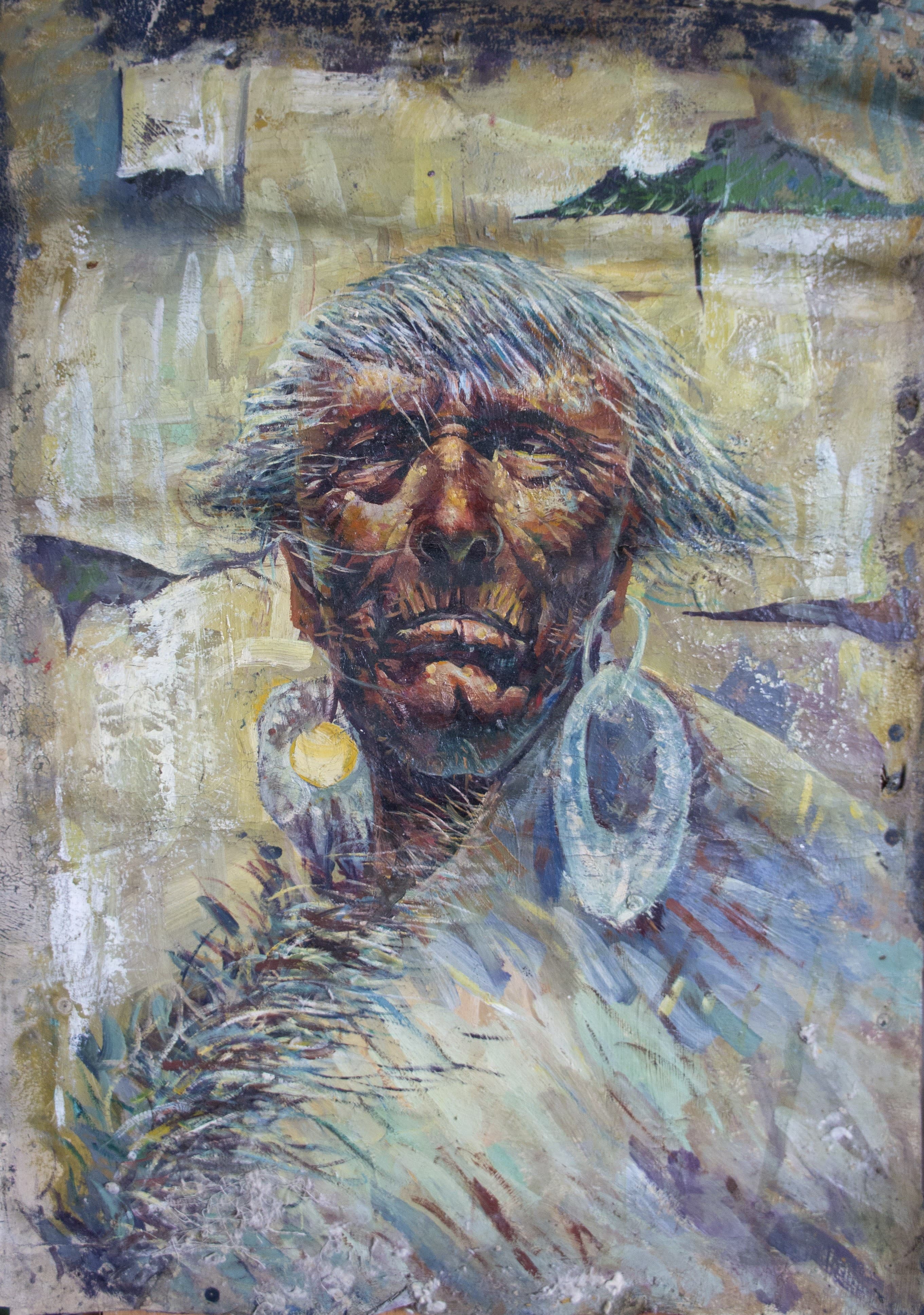
“My Grandfather,” 1989, oil painting, Kunming.
In 1988, the sixteen-year-old artist experienced a night in Kunming when he “could not sleep.” This moment, described as being “as if driven by spirits,” became the true starting point of his artistic career. Riding through the late-night streets, he cut a corner from a discarded advertising canvas he had picked up and, without any oil-painting training and with no one to guide him, painted from one until three in the small hours, completing the first oil painting of his life.
The Mu Clan at Lashihai: From Chieftain to Horse Caravan
The figure in the picture is no ordinary grandfather. The artist's ancestral home is Haidong Village at Lashihai in Lijiang; he is of the Naxi people, and his family are descendants of the Mu chieftains who ruled Lijiang for more than four hundred and seventy years (1253—1723). According to the “Genealogy of the Mu Officials” (Mushi Huanpu), the founding ancestor Ye Gunian was a chief of the Moxie tribe during the reign of Tang Gaozong, who seized the land of “Sandan” and laid the foundations of the family enterprise. In 1382, Ajia Ade submitted to the Ming dynasty, and Zhu Yuanzhang removed one stroke from his own surname “Zhu,” bestowing the Han surname “Mu,” and enfeoffing him as hereditary native prefect.
The distribution of the Mu family at Lashihai has clear genealogical record: during the Longqing era, Mu Cheng, the second son of the third generation, moved to Beigu Luwan north of the prefectural seat; in the fifteenth year of Wanli, Mu Cheng's son Mu Li led the family to move to the Mu Family Stockade at Lashi; in the thirty-fifth year of Yongzheng, the wife of Shilong — son of Mu Hui, the great-grandson of Mu Li — led two sons to move to the Mu Family Stockade, laying the family's foundation at Haidong Village, Lashihai.
Lead of the Horse Caravan on the Tea-Horse Road
The artist's grandfather was not only the former village head of Haidong Village at Lashihai, but moreover the lead of a horse caravan on the Tea-Horse Road (the “horse-pot head,” maguotou). Lijiang was a key town on the Yunnan-Tibet Tea-Horse Road; during the Ming and Qing the “He–Li” route replaced the Jianchuan route as the main line of the Tea-Horse Road. The Mu chieftains set up a “tax-inspection station” below Qiutang Pass, where all passing merchants had to pay duties, and from the Tibetan regions they collected “yak silver.”
During the War of Resistance, Lijiang became a goods-distribution hub of the great rear area; there were about more than one thousand five hundred trading houses along the Tea-Horse Road, with three to five thousand horses coming and going, and nearly twenty or thirty thousand horse-pot heads and horse-hands. The Naxi caravans carried tuocha and tube-tea from Pu'er and Simao, entering Tibet around the Dragon Boat Festival in the fifth month, and in autumn purchased caterpillar fungus, fritillary, musk, and hides to return to Lijiang. The foreign goods carried back from the other end of the trade — woolen cloth, woolen blankets, cigarettes, Western medicine, Swiss watches — sold very well in the Naxi and Tibetan regions.
The chocolate the artist's father ate and the Marlboros he smoked in childhood were precisely the “foreign goods” that the grandfather's caravan carried back from Calcutta via Lhasa and Lijiang. These modern commodities from the far end of the Tea-Horse Road constitute the most vivid material clue in the family memory.
From Horse Caravan to Tea Dāna: A Tea Civilization Across Four Generations
This family memory forms a profound bloodline link with the artist's later art projects carried by the civilization of tea. The grandfather's caravan carried tea toward the southern foot of the Himalayas, transporting Pu'er tea from Yunnan to Tibet, Nepal, and India — this was a corridor of civilization with tea as its medium, and also the trade network on which the family depended for survival.
Decades later, the “Tea Dāna” projects the artist carries out around the world are precisely a contemporary response to, and transcendence of, this family gene. From the caravan's material trade to Tea Dāna's spiritual transmission, from the regional network of the Yunnan-Tibet road to art actions on a global scale, tea has always been the medium connecting family memory and contemporary practice. The grandfather used the caravan to carry tea to distant places; the grandson uses art to give tea, as a symbol of civilization, to the world — this is a dialogue across four generations, the reincarnation and continuation of the family bloodline in art.
Three Deaths and Hereditary Fate
The family genealogy was repeatedly torn apart by historical violence: the grandfather, as a Lijiang headman, former village head, and lead of the horse caravan, “went off and never came back” in the early years of New China after Mao Zedong feasted all the local gentry — a political death; the maternal grandfather, a wealthy scholar (xiucai), was killed by the British opium paste — a colonial death; the second uncle, who before the Cultural Revolution was admitted from Lijiang to Tsinghua, took his own life under wrongful humiliation in struggle-sessions — a death of the political campaigns. The three male ancestors were swallowed by the age in three different ways: political, colonial, and campaign.
From Absence to Presence
Having never seen his grandfather, his maternal grandfather, or his second uncle, and never truly come into contact with Naxi culture — this manifold absence instead gave rise to a kind of “arrogant curiosity.” The grandfather is therefore not only a blood ancestor but is also endowed with a mythological dimension: he is, in the artist's mind, a “Chongren-Li'en-type incarnation” — the migrant who, in the Dongba creation epic, connects the heavenly realm and the mortal world, the origin-point in the family narrative that is forever present yet never appears.
The back of the canvas to this day still retains the remnants of the commercial advertisement, while the front is a youth's imaginative portrait of his absent grandfather. This “sacred writing upon a discarded object” foretold the methodology consistent throughout the artist's later creation: to unearth memory from ready-made objects, to construct presence in the place of absence, to write personal history as ethnography, to resist with art the twofold fate of heredity and history. Beginning with this picked-up discarded canvas, a life-long cyclical self-observation was opened — from the naïve daubing at sixteen to the creative practice still continuing at fifty-five, this earliest oil painting is like a seed, containing the genes of all later creation: the relentless inquiry into identity, the gaze upon and transcendence of death, and the conviction of giving form to life through art.