The Full Essay
Full Essay
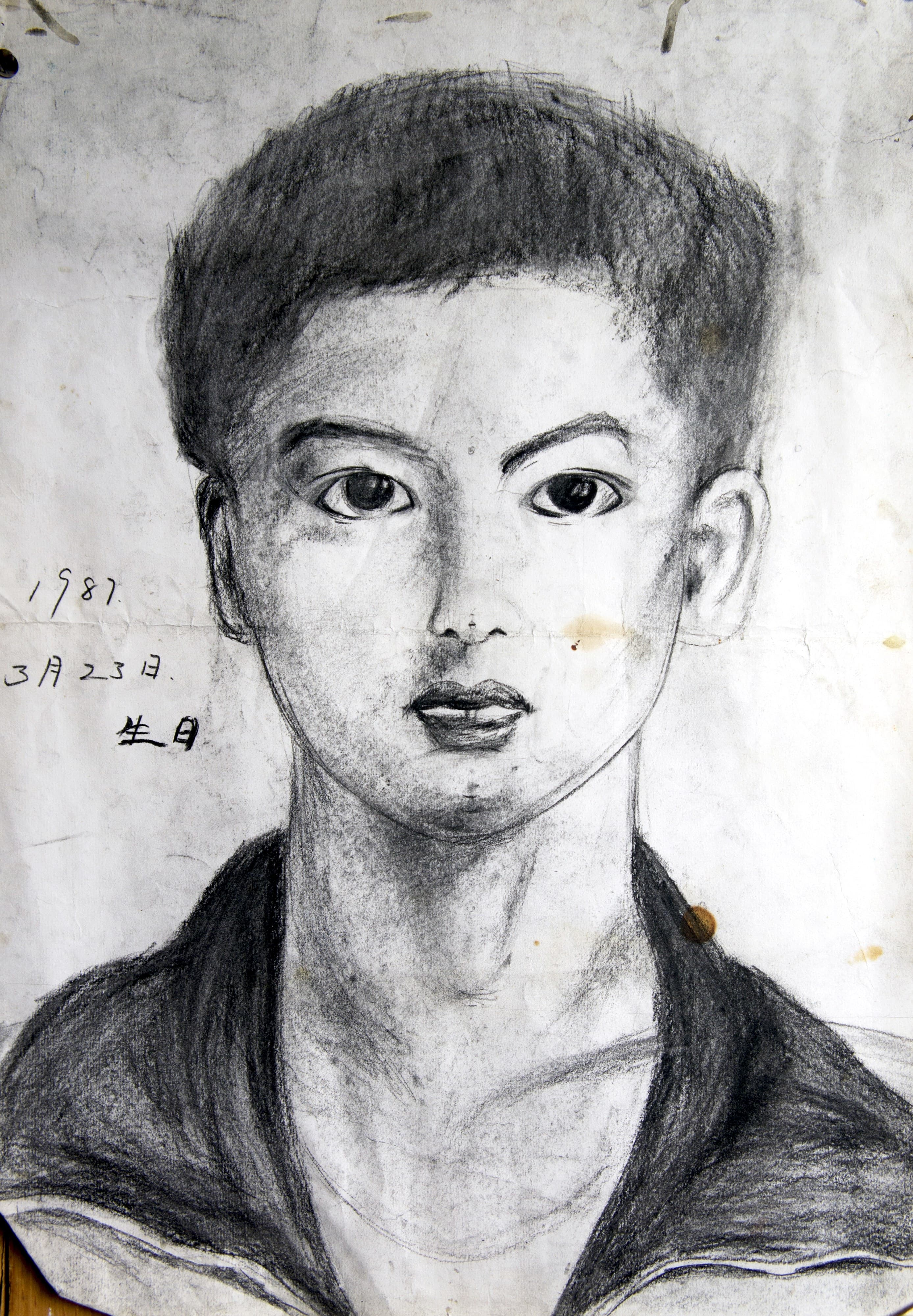
On 23 March 1987, his fifteenth birthday, a youth walked toward the stream at Xishan in Kunming with an almost joyful bearing. This was not an accidental outburst of adolescent depression, but a deeply considered philosophical action — as an early awakener among humankind, he took suicide as the most thorough active resistance and refusal against humanity's passive fate; this is the most extreme, most pure oath of human autonomous consciousness.
This decision was not an isolated life-event but a hidden echo of the family's history of trauma. The artist's second uncle — his father's younger brother — was admitted to Tsinghua University during the Cultural Revolution, yet was struggled against because of the grandfather's “historical problem” status as a “former village head”; unable to bear the humiliation, he ended his own life, leaving that “ugly world” through death. The second uncle and the youth-artist's decision were identical: both took suicide as the ultimate refusal of institutional violence, both an extreme declaration of resisting the great collectivist totalitarianism with the flesh. Yet the second uncle did not cross the threshold of life and death; his “Third Kingdom of Jade Dragon” was realized in the manner of an ending. The artist, however, was held back by the radiance at the Xishan stream, and through art as medium built the “Third Kingdom” on the near shore of the living. This mirror-structure of family fate makes the artist's survival a continuation and transformation of the second uncle's death — not entering mythic space through death, but continuously expanding the territory of myth through creation.
That afternoon, as he walked around the park, his capacity to commune with heaven and earth let him see through the entire operating mechanism of society: schooling, examinations, finding work, marriage and childbearing, serving one's parents, aging, death — this is not the natural unfolding of life but Foucault's precise governmentality of “biopolitics,” the collective-unconscious sinking of Heidegger's “the They” (das Man). Everyone is a prefabricated part on this great machine, programmed from birth into a calculable trajectory, completing self-surveillance within “normal” collective life, never questioning whether this assembly line is a collective hypnosis. The youth decided to take suicide as the ultimate gesture of non-cooperation; this was not cowardly escape but the most radical oath of autonomous consciousness: when the individual refuses to become fuel for the production machine, when life is no longer requisitioned by the institution, it is an extreme methodology of resisting systematized existence with the flesh, forcibly interrupting the karmic flow of passive fate.
From this angle, the artist's attempted suicide and his subsequent artistic practice can be seen as the modern transformation of the Naxi tradition of “dying for love.” In the Naxi Dongba religious myth, the young men and women who die for love do not fall into the cycle of rebirth but enter the “Third Kingdom of Jade Dragon” — an eternal paradise guarded by the love-gods “Youzhu” and “Gouzhu,” where “there are no mosquitoes to bite, no venomous snakes about; the tiger serves as mount, the white deer as ploughing ox,” the ultimate refuge beyond worldly suffering. The artist's grandfather, as a “Chongren-Li'en-type incarnation” — the ancestor in the Dongba creation epic who descends from the heavenly realm and, through ordeals, establishes the order of the human world — together with the love-god couple of the Third Kingdom of Jade Dragon, jointly constitute the myth-dimension that crosses life and death in the family narrative. Yet the artist did not choose to enter the Third Kingdom of Jade Dragon through death, but created a “Third Kingdom” through art — a space where autonomous consciousness can remain continuously present. The self-portrait series becomes the architectural blueprint of this “Third Kingdom”; every recorded stroke is the contemporary manifestation of the love-gods “Youzhu” and “Gouzhu”: not through the ending of dying-for-love, but through continuous creation, anchoring the transcendent dimension on the near shore of the living. The second uncle's death becomes the first cornerstone of the “Third Kingdom”; the artist's survival becomes its continuing construction.
Suicide here acquires an entirely new philosophical definition — it is not a negation of life but a thorough refusal of the “prescribed life,” the sole path by which autonomous consciousness forcibly breaks out of the collective unconscious. The youth goes to death with joy, because he has finally seized back the dominion over his life: not passively accepting the script allotted by society, but actively choosing to end this directed drama. This is the extreme practice of Sartre's “existence precedes essence”: before being defined by society as “who you are,” to first declare through death “I refuse to become the me you prescribe.” It is also a radical answer to Camus's “only truly serious philosophical question”: when Sisyphus realizes the absurdity of pushing the stone up the mountain, the youth chooses, by way of pushing it off the cliff, to refuse to take part in this game of eternal recurrence.
Yet when he stood at the threshold of life and death, his capacity to commune with heaven and earth suddenly awoke, revealing a deeper dimension of existence. The barriers of space-time dissolved, all things were infused with boundless radiance, the manifold layers of existence unfolded at once — within the intense light of the “dharmatā bardo,” the “child luminosity” and the “mother luminosity” met. This was not an illusion but the reality beheld by autonomous consciousness after breaking through collective hypnosis: that magnificent existence is not the reward of “another world” but a truth concealed in the present — the cage of humanity's passive fate is unbreakable only because autonomous consciousness is systematically suppressed. The youth realized that death is not the only path of resistance; the capacity to commune with heaven and earth can keep operating in the living state, and art is precisely the medium that keeps this autonomous consciousness open and unfolds a continuous critique of the institution. The refusal the second uncle completed through death, the artist continuously re-enacts and transforms through art — every act of creation is a renewed refusal of that “ugly world,” every recorded stroke a silent response to the second uncle.
Examined from the angle of the philosophy of art, this awakening carries a profound paradigmatic significance. In “The Work of Art in the Age of Mechanical Reproduction,” Benjamin mourns the disappearance of the “aura” — traditional art, in mechanical reproduction, is stripped of the “here and now” uniqueness and cultic value, reduced to an infinitely reproducible consumer commodity. Yet the boundless radiance the youth saw at the threshold of life and death is precisely the most primordial, most unreproducible manifestation of the “aura”: it occurs only in this moment, this place, this flesh, unable to be captured by photography, unable to be transcribed by language, still less to be co-opted by the institution into a consumable sign. The next day he enrolled in an art class — precisely setting down a contract in the sense of the philosophy of art: to take art as the sole “method of practice,” continuously recalling and guarding this “aura” on the verge of vanishing, resisting the capitalist production machine's reproduction and requisition of all experience. The “aura” the second uncle failed to guard, the artist rekindles through forty years of continuous observation.
The self-portrait series thereby becomes a lasting archaeology of the “aura,” and also the continuing construction of the “Third Kingdom of Jade Dragon” in the contemporary. From age fifteen to age fifty-five, every record is a refusal of “mechanical reproduction” — the stroke of the pencil, the texture of oil paint, the bleeding of ink, are not a reproduction of the image but an irreducible inscription of the “here and now” state of existence. Adorno's critique of the “culture industry” here gains a bodily practice: when all emotion is prefabricated into consumable signs, the self-portrait defends the uncodability of experience with extreme individuality. The “storyteller” of whom Benjamin spoke dies out in modern society, yet the artist, through forty years of continuous self-observation, becomes the last storyteller — the object of the story is himself, the audience is the awakeners of the future, and the “Third Kingdom of Jade Dragon” expands its territory in every stroke; the second uncle's silence is translated into visible language in every stroke.
Further, this artistic practice echoes the philosophical proposition after Danto's “end of art”: when everything can be art, the definition of art turns toward “the theory of art.” The artist's self-portrait series is not a “good work” in the traditional sense; its value lies precisely in its “imperfection” — the unpolished strokes, the clumsy composition, the untrained perspective, these are all a refusal of the “Institutional Theory of Art.” When the museum, the market, and the critical world jointly define “what art is,” the artist proves through continuous action: art can happen outside the institution, the “aura” can flicker on the plainest sheet of paper, the “Third Kingdom of Jade Dragon” can be built in the most private studio, the second uncle's death can be commemorated in the most everyday act.
Ordination in Myanmar is not a conversion to a religious system but the dismantling, through individual action, of the sign-violence of religious art, purifying the frequency of the “Third Kingdom” within the precepts; the Three Years Retreat is not an escape from society but the testing, through extreme solitude, of the stability of the “aura” in a state of isolation, expanding the territory of the “Third Kingdom” within the tantric tradition of “retreat”; “donating the self” is not a charitable performance but the emptying of the individual from the subject-position of consumerism, achieving the most thorough autonomy — when even the “self” can be actively relinquished, art is no longer “the artist's work” but the direct manifestation of the “Third Kingdom”; the “Zhuangzi Project” is not a cultural survey but the verification, across the world's different coordinates of totalitarianism, of the cross-cultural uncodability of the “aura,” extending the map of the “Third Kingdom of Jade Dragon” to the Maya civilization, the Mediterranean coast, and the jungles of Southeast Asia, transforming the second uncle's individual tragedy into a global archive of resistance.
Looking back at age fifty-five on this 1987 drawing, its meanings of the philosophy of art, family myth, and historical trauma fully appear: it not only records a personal awakening but becomes a transmissible “archive of the aura” and a “map of the Third Kingdom” — proving that passive fate can be refused, that collective hypnosis can be broken, and that the “Third Kingdom of Jade Dragon” need not be entered through death but can be continuously built through art. The second uncle's suicide and the artist's survival constitute a dialogue across life and death within the family fate: the second uncle proves through death that the institution's violence can destroy the flesh; the artist proves through art that the institution's violence cannot destroy the “aura.” The grandfather's “Chongren-Li'en-type incarnation” and the love-god couple of the Third Kingdom of Jade Dragon attain a modern transformation in the forty-year self-portrait series — not through the ending of dying-for-love, but through the eternity of creation, anchoring the life-and-death-crossing myth-dimension on the near shore of the living. The reason the artist tirelessly “self-archaeologizes” is precisely that he knows there are still countless “second uncles” falling silent in the institution's struggle-sessions, and countless sentient beings drifting in stupor within the “bardo of ordinary beings,” needing this archive to prove: that recognizing the “luminosity of dharmatā” is possible, that abiding in “clear awareness” in the living state is possible, and that the “Third Kingdom of Jade Dragon” continuously expands in every stroke, every moment, every oath of autonomous consciousness — building, for all those who could not cross the threshold of life and death, a refuge on this near shore.
That radiance upon Xishan still flickers in the picture to this day — it is not a phantom of memory but the continuous manifestation of the “mother luminosity” and the “aura,” the entrance to the “Third Kingdom of Jade Dragon” on this near shore, the second uncle's silent response, awaiting every traveler who is ready to awaken from passive fate, ready to build his own “Third Kingdom” through art.