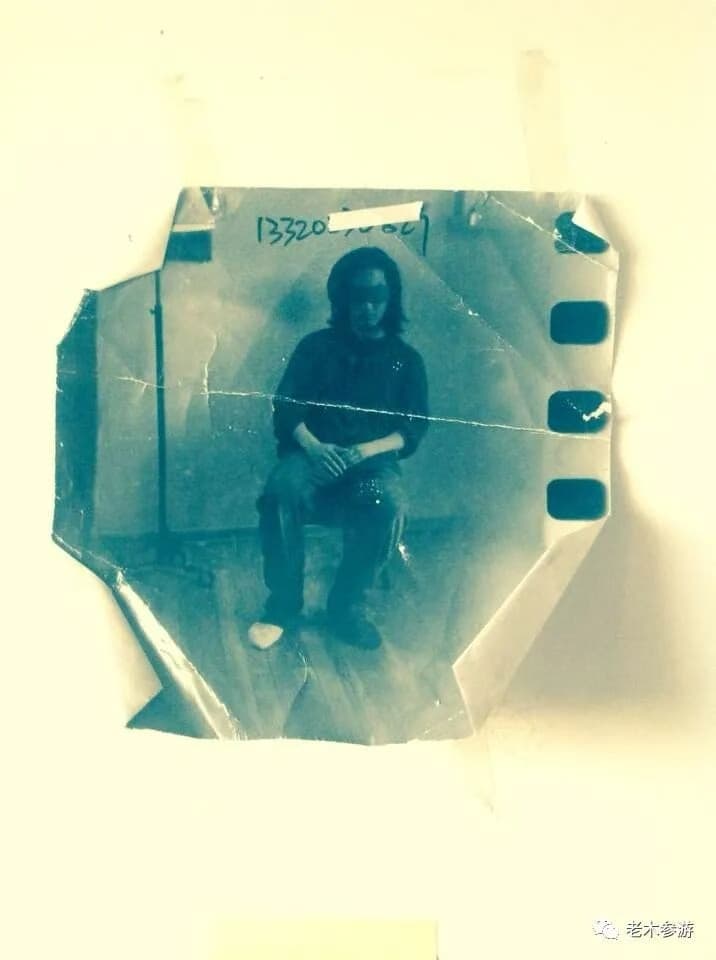
木玉明
Projects
Performance·2021 — 2022

My Second Face

第二张脸 · Kunming, Yunnan, China

A mask, like a myth, cannot be understood in isolation, or explained solely from the mask itself as a standalone object. From a semantic point of view, only by placing it within a variety of combinations does a mask acquire meaning.

01

Origins

Swimming gear arranged on a riverbank — form as figure, figure as absence. From the Maska series.

Three thousand years ago in written Chinese, masks were called jiamian (假面), rengtou (扔头), and taotou (套头). Among folk artists and ordinary people in daily conversation, they were called lianzai (脸子), mianka (面壳), and guilian (鬼脸) — objects formed by the solidification of multiple human consciousnesses, containing special meaning.

Mu Yuming's first mask was made as a child, playing games with other children. He can no longer remember what it looked like. As an adult, he continued making masks in every period of his life — mostly in an unconscious state, without any specific purpose, simply for fun.

In the ancient Naxi creation mythology epics — 《尝搬崇第》and 《董术战争》— water holds central importance in the cosmology of Mu Yuming's ancestors. Breath, dewdrops — all are forms of water. The five basic elements that constitute all things evolved from water. Water is the foundation of all.

This cosmological understanding — that surface and substance are transformations of the same origin — runs beneath My Second Face as an unspoken premise. The face we present is not the face we are. The mask is not concealment; it is a different kind of revelation.

By 2021, the personal practice of mask-making had accumulated enough weight to become a project.

02

Jingdezhen, 2014

Before the project had a name, it had a period. The years around 2014, spent in Jingdezhen, form the most intensively documented prehistory of My Second Face.

This was also the period of Lao Mu's 'three-year seclusion project' — an extreme, anti-conventional personal experiment that he has described as nearly costing him his life and that put him in a wheelchair for six months. It was in these circumstances — stripped of ordinary social interaction, living in a deliberately constrained way — that mask-making intensified.

The records from this period document a mind in free movement: sunflower seed shells piled on the Jingdezhen terrace and then eaten away to nothing by sparrows over two months ('emptiness is still continuing to develop'); river swimming in flooded mountain streams at forty or fifty kilometres per hour until the current swept him hundreds of metres downstream; found objects arranged into faces and then disassembled; the daily practice of art approached as something that existed long before it became a profession or an identity.

From this time comes a sequence of poems about loneliness and the mask: 'Only loneliness can unmask you / Only emotions are your companion.' And another statement of artistic principle, written into the record of those years: 'You do not need to make yourself up as an artist to make art. You do not need to dress yourself up as a craftsman either. Art was originally very good, very relaxing — from ancient China, ancient India, ancient everywhere. Now it has become fashion, a magic tool for transforming identity. Art can never be categorised as a profession. Artists must always be self-generating and self-sustaining.'

Also from this period: a performance artwork staged at Jingdezhen's Huangnitou clay area, drawing on the lives of two Tang dynasty figures. Character A was the calligrapher Zhang Xu (张旭): a man who loved wine, grew drunk, then ran while writing, sometimes using his own hair dipped in ink — and on sobering, would admire what he had made, believing supernatural forces had assisted him. Character B was Yan Zhenqing (颜真卿): as a child too poor for paper and brushes, he practised writing characters on walls with yellow mud mixed with water. Later he studied under Zhang Xu and created his own monumental calligraphic style — transforming thin hardness into rich boldness. Materials for the performance: twenty square metres of artificial garbage at Huangnitou, and tree trunks from illegal logging nearby.

Lao Mu connected this period's work to the Song dynasty landscape painter Fan Kuan (范宽): 'Fan Kuan loved wine, was unconstrained by convention, could penetrate deeply into life, and thoroughly studied the natural world — eventually moving to the Zhongnan and Tahua Mountains for long-term observation and sketching, until the landscape's spirit was fully absorbed into him.' Of his own practice in this period, he wrote: 'Lao Mu loves colour — all kinds of colour. Lao Mu takes as his teachers urban garbage, pollution, all kinds of noise, all common people and common things. He enjoys extracting essence and absorbing energy from discarded objects.'

03

NCAB & Maska

Found objects assembled as a face — straw hat, goggles, keys. Studio experiment from the Second Face series.

The project moved into public space with two events in late 2021. The first, NCAB First, took place in October — documenting the initial public presentation of the Second Face work. The second, the Maska Project, followed in November.

Maska — the word for mask across Slavic and Romance languages — brought the project into dialogue with international traditions of mask-making and identity performance. The Naxi mythology of water and transformation, the Lévi-Strauss insight that masks only acquire meaning in combination, the intimate found-object explorations of the studio: all of these threads converged in the live work.

A third event, Two Faces — Conscious People, followed in December 2021 — extending the project's inquiry into what it means to be aware of having a second face at all.