The Full Essay
Full Essay
Oslo, capital of Norway, 1997.
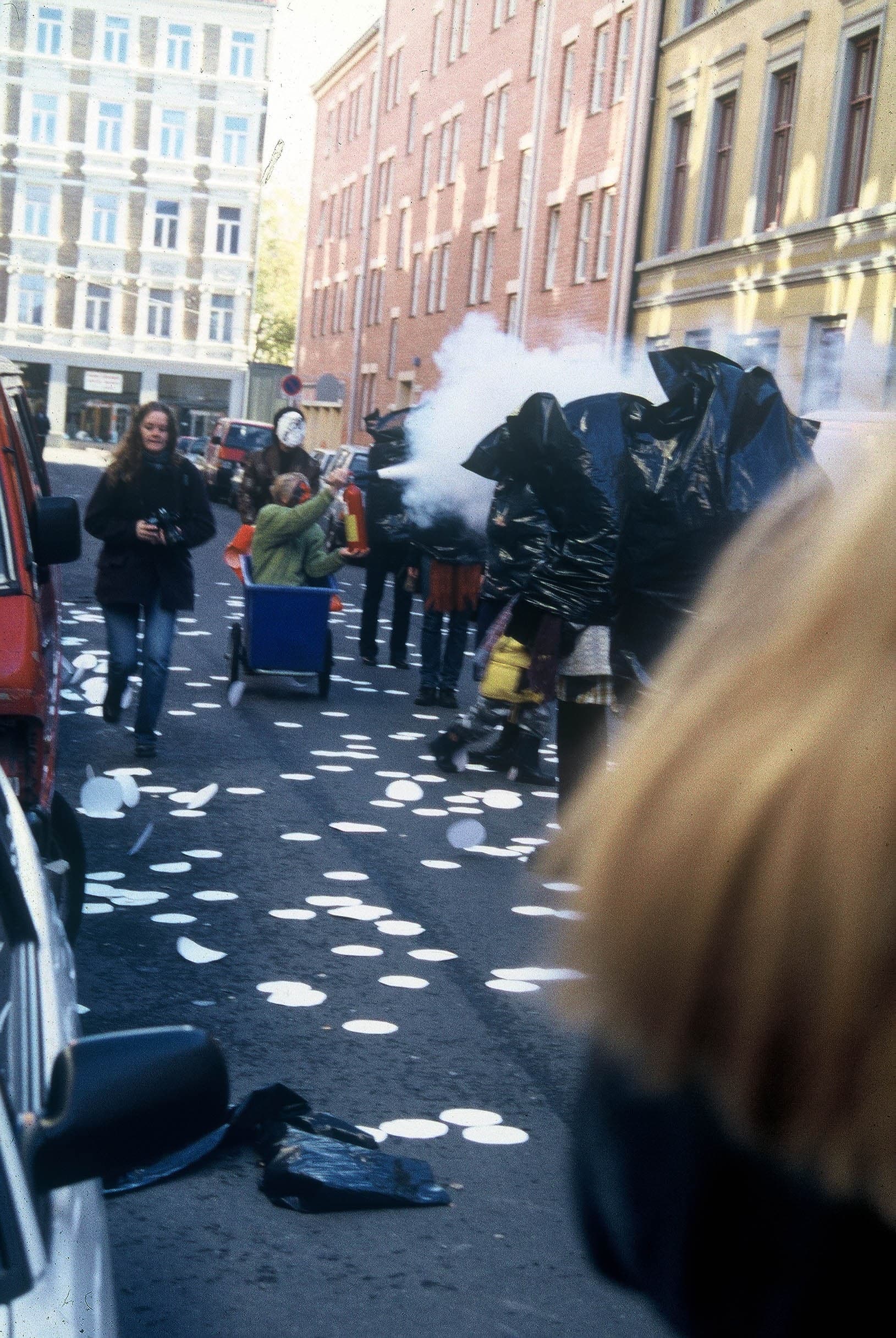
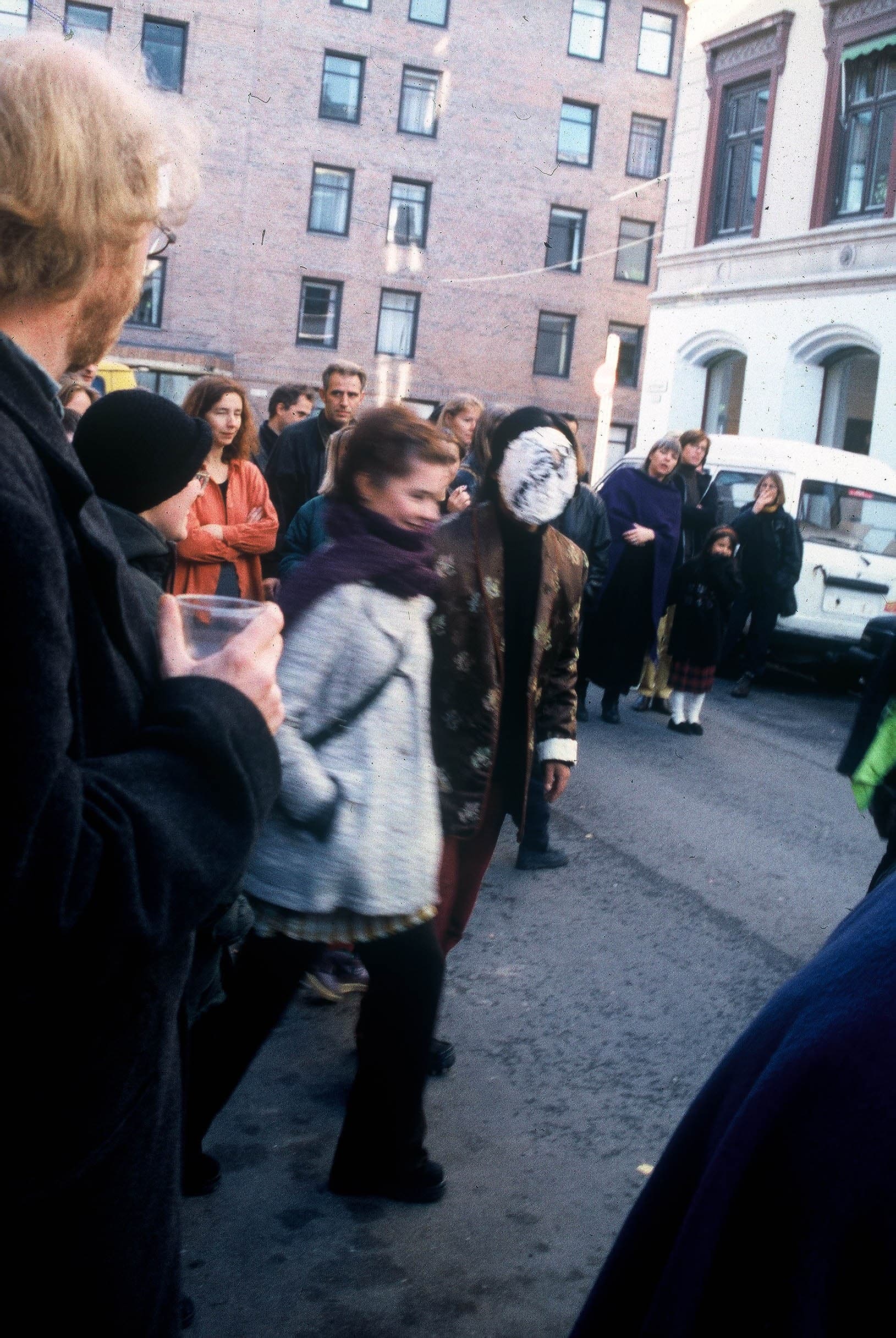
In 1997, while studying in the experimental art department of the Norwegian National Academy of Fine Arts (Statens Kunstakademi i Oslo), the artist took part in an Oslo group show of young artists and carried out this public-art project centered on performance. This was an important practice among the many interventionist works of his Norwegian period, and moreover the conceptual rehearsal and material precursor of the “Self-Mask” series shown in the 2000 graduation work at the Museum of Contemporary Art.
The work is deeply rooted in the tense atmosphere of European immigration policy in the 1990s. The artist placed his own “new immigrant” identity in the public field, using the body as medium to transform cultural dislocation and political sensitivity into perceptible on-site experience. The core mechanism was built on a twofold structure of confinement and conflict: in collaboration with his fellow student Ivan, plaster masks covered the face — the mask is at once a dissolution of identity and a disguise of identity; black plastic bags confined the audience within an enclosed space, a metaphor for the immigrant's encirclement and transparent existence within a heterogeneous culture; around the perimeter, foam fire-extinguishers sprayed large amounts of foam liquid, constituting a violent shock to the perceptual system.
The continuity of material is the key to understanding this work's connection with the graduation work. The plaster masks used here were later cast in fiberglass and became the core element of the 2000 graduation work shown at the Museum of Contemporary Art. From the temporary site of the 1997 group show to the institutionalized space of the 2000 museum, the mask completed its transformation from an “action tool” to a “display object,” marking the artist's deepening from immediate bodily intervention toward systematic conceptual construction. The fragility of plaster and the solidity of fiberglass constitute a twofold variation of material semantics: the former points to the immediacy and danger of the on-site action, the latter intimates the durability and monumentality of the identity question.
The on-site loss of control strengthened the social dimension of the work. The police questioning encountered during the action was not a preset episode but a real social reaction — it confirmed the sensitivity of the immigration question and made the work slide from an “artistic action” toward a “social event.” The police intervention blurred the boundary between creation and life, strengthening the “being scrutinized” and “being disciplined” of immigrant identity in public space.
From an academic genealogy, this work continues the European performance-art and institutional-critique tradition of the 1970s, injecting a postcolonial perspective. The audience turns from “viewer” into “experiencer,” bodily feeling the immigrant's suffocation and aphasia. And the cross-temporal reuse of the mask material further makes the 1997 site the “rehearsal text” of the 2000 graduation work — the two exhibitions form an intertextual relation: the former an immediate conflict of identity, the latter a systematic archaeology of the self.
With its “uncollectable” on-site character and its material's preliminary experiment, this work becomes the most avant-garde case in the artist's early creation, and a precious document of a 1990s Chinese artist intervening in the question of identity through performance in Europe.