The Full Essay
Full Essay
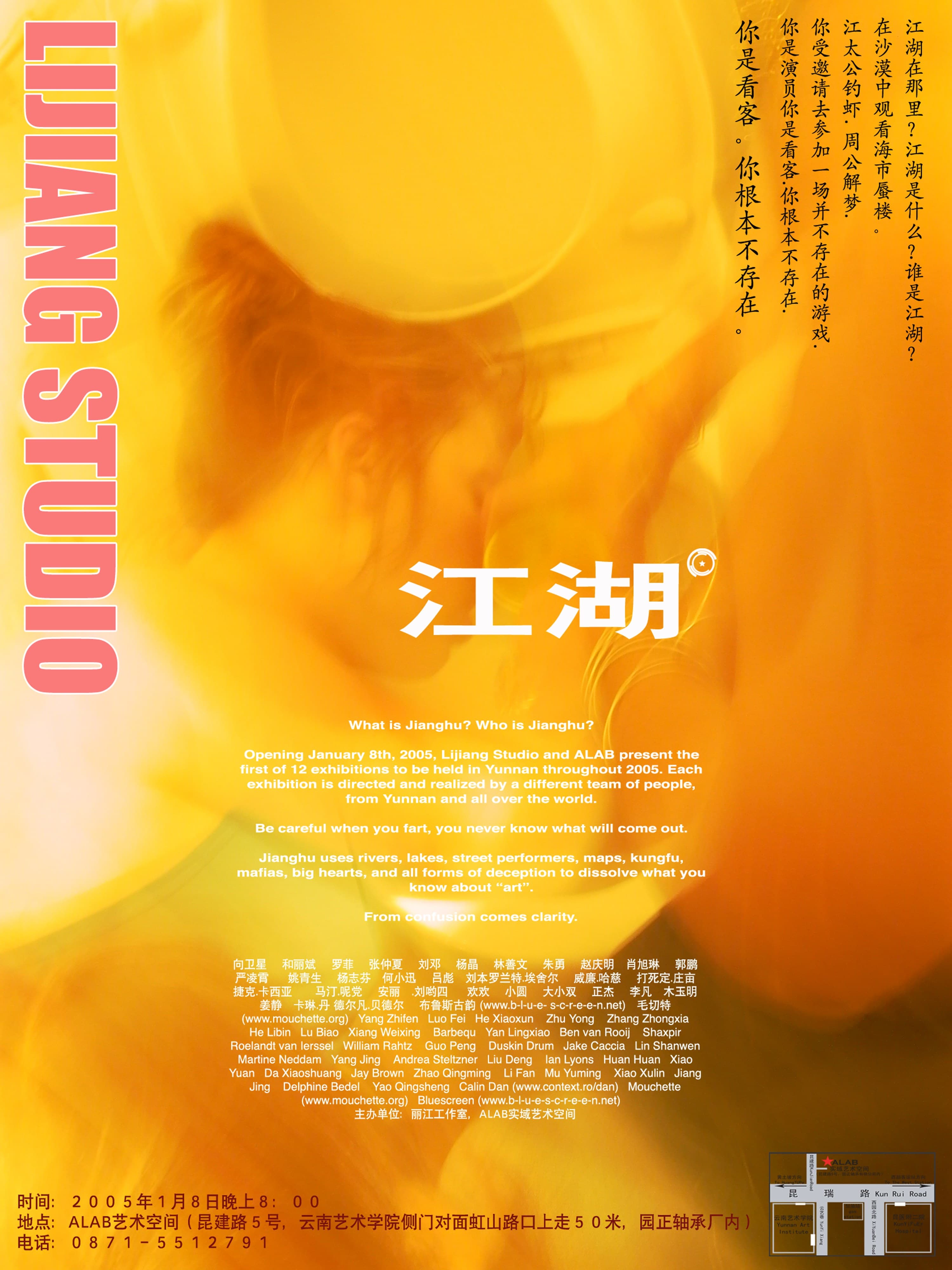
“Jianghu” (Jianghu, 2005–2006) is a twelve-month series of experimental art activities planned by the artist Mu Yuming (Lao Mu), jointly hosted by Lijiang Studio and the ALAB art space, in twelve rounds, independently curated by twelve curators (or groups) including Mu Yuming, Xiang Weixing, Luo Fei, He Libin, and Jay Brown, forming a decentralized curatorial network. The project took Beuys's “social sculpture” (Soziale Plastik) and “everyone is an artist” as its theoretical undertone, yet took the traditional Chinese concept of “jianghu” as its native foundation, forming a creative grafting of Eastern and Western art philosophy at the level of rules.
The project's breakthrough lies in its highly autonomous yet strictly constrained operating mechanism. Lao Mu designed a series of “game rules” as the art material itself: first, setting up a real boxing ring, pushing the conceptual conflict between professional and non-professional curators from the level of discourse to bodily confrontation, transforming conflict itself into productive exchange in the logic of what Claire Bishop calls “antagonistic aesthetics”; second, laying down the “severed finger” rule — a curator absent from an activity must pay a fine of 3,000 RMB and “leave one finger behind, exactly which finger being one's own to decide, the executing tool one's own to choose,” a violent contract of black humor ironizing the soft discipline of the art institution, combining the folk character of gangster narrative with a Fluxus-style body-politics; third, setting an economic constraint of a 5,000-yuan fine for withdrawing midway, opposing the market logic itself through the extremization of market logic.
Even more theoretically profound is Lao Mu's strategy of identity-dissolution. He deliberately concealed his identity as curator and founder, so that every participant, including the American collaborator Jay Brown, regarded himself as the creator — this operation pushed to the extreme the hypothesis of the “micro-utopia” in Nicolas Bourriaud's “relational aesthetics,” yet also, with a Saidian cultural self-awareness, guarded against the subjective overreach of Western collaborators in cross-cultural projects. On the day of naming, Lao Mu phoned forty Chinese and foreign people to ask the meaning of “jianghu,” and “no two said the same thing” — this episode itself constitutes a deconstruction of conceptual fixity, confirming the folk character of “jianghu” as a fluid signifier.
After Jay Brown refused to fund it, Lao Mu replaced institutionalized funding with public crowdfunding (50 yuan per person), the funding for each exhibition being only 1,500 yuan, yet achieving a spatial overflow from the white box toward the street, the countryside, the mountains and wilds, the rivers, and even Amsterdam. The twelfth round, jointly curated by twelve curators, presented a “leaderless” state, foretelling Lao Mu's strategic turn.
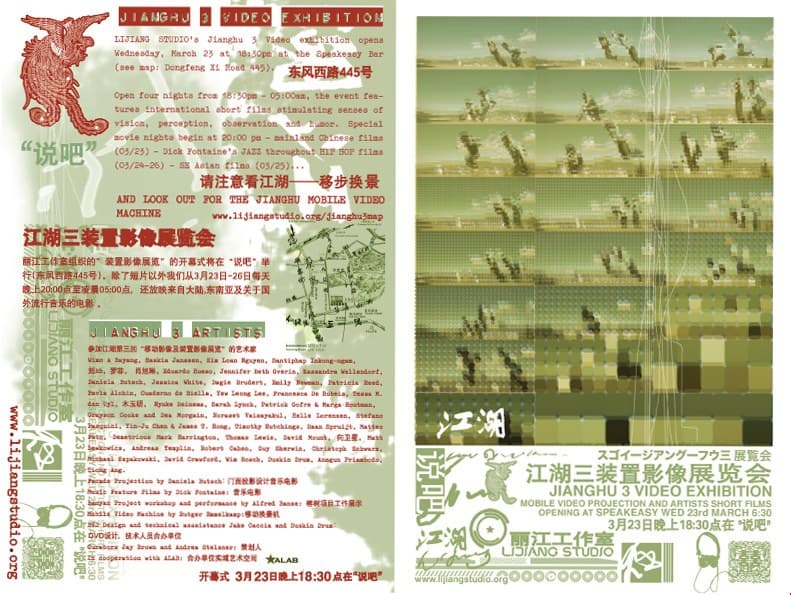
The “Jianghu” exhibitions spread throughout the streets and lanes of Kunming, Lijiang, and other Chinese cities, and extended with Lao Mu to Amsterdam. Its influence far exceeded Yunnan itself — Sina's collection channel called it “the largest outdoor art movement in China,” and the project was finally invited to exhibit at various art biennials in the Netherlands, the United States, Shenzhen, and Beijing, including the exhibition of the “Jianghu” series at the Tilton Gallery in New York in 2006, marking this grassroots movement's recognition by the international art world.
The evaluations of those who experienced it firsthand constitute an important dimension of “Jianghu's” historical positioning. The artist Xue Tao pointed out: “The last relatively concentrated experimental-art creation by Yunnan artists was the ‘Jianghu’ of 2005 to 2006.” The curator He Libin recalled: “From 2005 to 2006, the participating artists reached several hundred, and foreign artists made up nearly half. A single exhibition alone sometimes had several hundred participants. Only a way like ‘Jianghu’ — resembling a festival, a celebration, a carnival — could bring together so many different types of artists from Yunnan and abroad. The ‘Jianghu’ without hierarchy or boundary brought together Chinese and foreign people of different professions; ‘Jianghu’ has precisely this characteristic, and only this equal, inclusive, grand-reunion way could gather so many ‘artists.’” He Libin also mentioned that at the time “Jianghu” was promoted through blogs: “Once an activity was held in Kunming, artists everywhere else in the country knew about it. The discussion was also on the blogs, the arguments very fierce, the artists all very serious, mulling over a very small question again and again, replying to letters repeatedly.”
In 2006, Mu Yuming actively halted “Jianghu” during the open-studio period at the Rijksakademie in the Netherlands. This termination was not the result of the impact of art's marketization — as He Libin clarified, “the end of ‘Jianghu’ had nothing to do with marketization” — but the artist's clear-eyed recognition that, although an emotional collective movement could produce the sensational effect of “emptying the streets,” it was hard for it to achieve structural change in native art. Thereby Lao Mu withdrew from the temple-fair-like collective movement of “Jianghu,” turning toward more personalized, extreme creative paths such as “Farmer Station” and “Playing the Human World” — from the organized collective jianghu, withdrawing into the personalized mountain-and-wild ‘zhuangzi’ (stake).