The Full Essay
Full Essay
“Kill · Brothers.”
Experimental video installation, 2000.
In 2000, Mu Yuming created a diptych experimental video, joined above and below by “Kill” and “Brothers.” Taking a collision of dreams as the narrative starting point, it places the everyday street life of Kunming within the context of China's drastic social transformation in the 1990s, forming a contemporary allegory of “slaughter” and “survival.”
The first part, “Kill,” records the slaughter assembly-line of a Kunming vegetable market — animals are imprisoned in cages from birth, pushed onto the slaughter line months later, collectively and silently watching their companions pushed onto the guillotine. This cycle has been internalized as “the natural order,” just as humans wait silently on their own assembly line. Philosophical thought surfaces here: Heidegger's “Being-toward-death” — the animal's unawareness of its own death is precisely a metaphor for “the They” in the oblivion of being, arranged by technological rationality into the framework of “Enframing” (Gestell), life reduced to a calculable resource.
The second part, “Brothers,” turns to the consumption scene of young people on the urban margins. Friends drink Western beer and coffee, come into contact with Western civilization, and in a “hyper-reality” seem to live within a dream. They appear to have escaped the assembly line of slaughter, confirming within the cage of consumerism their position as the “strong.” Yet Adorno's critique of the “culture industry” echoes here: when freedom is disguised as commodity choice, the “brothers” are merely the “slaughtered” on another assembly line, their “initiative” precisely the deepest passivity.
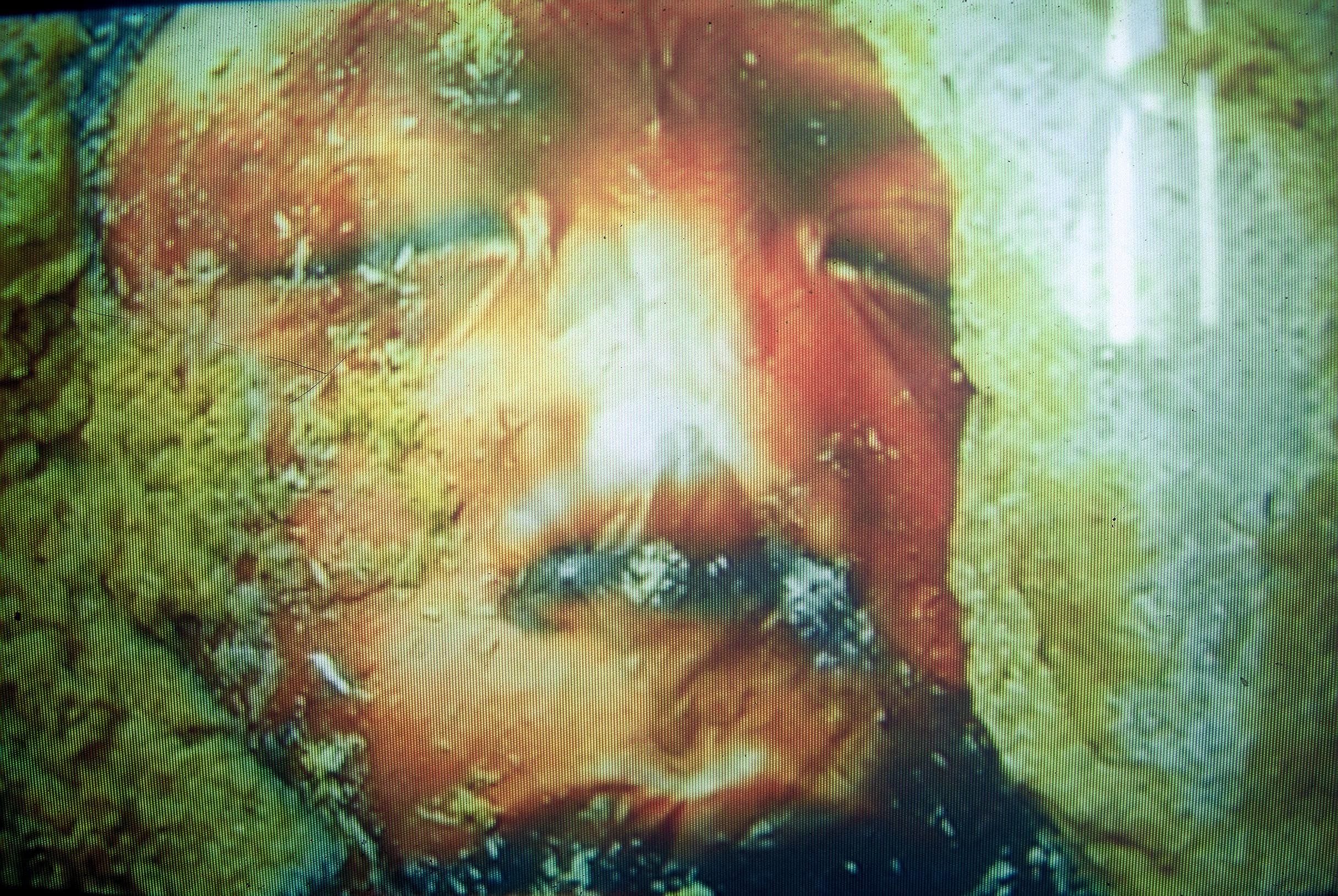
The work's temporal anchor carries great historical weight: one day in the 1990s, the artist was walking on the streets of Kunming when a small shop's television was playing the footage of the Twin Towers of the U.S. World Trade Center being struck by planes, a huge red fireball falling. From the Crusades to the U.S.-Iraq war, the global structure of violence is juxtaposed with the micro-slaughter of the Kunming vegetable market, forming an intertextuality of the local and the global. Agamben's concept of “homo sacer” here gains an imaged presentation — whether the animals awaiting slaughter or the victims on television, all are thrown into the bare-life state of “that which may be killed but not sacrificed.”
As a video installation, the juxtaposition of two screens makes the rhythm of slaughter and the scene of consumption resonate, and the DV image quality becomes a material testimony of the 1990s. In 2000 he was invited to the Nikolaj Copenhagen Art Center (Copenhagen, Denmark) to take part in the Asian single-channel moving-image art exhibition.
The work's core points to the mutual dependence of humanity and nature, and to the anxiety of the age in which we live — “Kill” and “Brothers” are two sides of the same coin: the passive being-slaughtered and the active survival of the “strong” share one and the same inescapable structural violence. Philosophical thought here is not an added interpretation but the work's own questioning: when technology incorporates all life into a calculable framework, can art, in a posture of “unconcealment,” reawaken the concealed truth of being?