The Full Essay
Full Essay
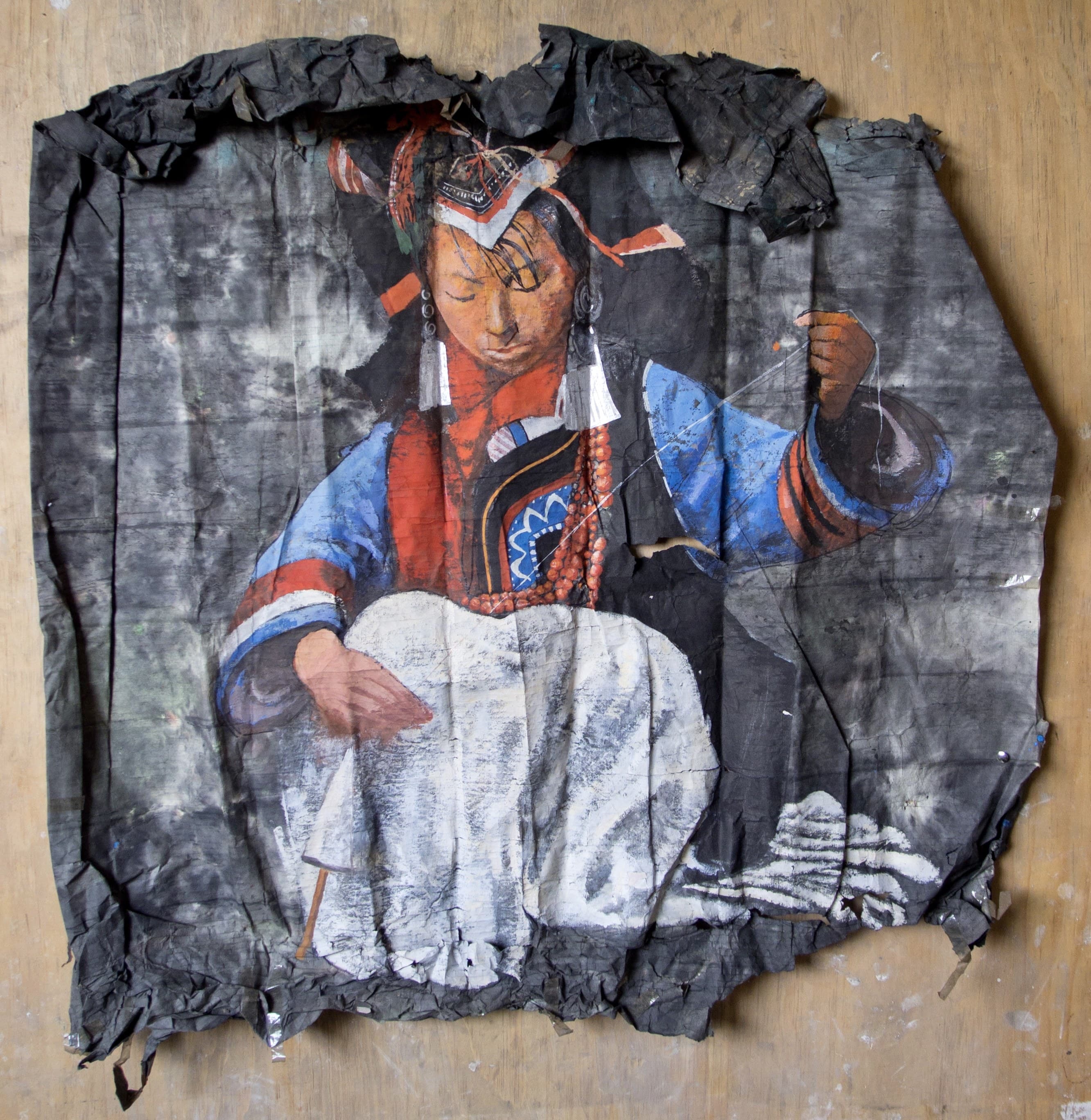
“Weaver Girl,” created in 1991, originates in the artist's field investigation and on-site sketching of the Yi-inhabited area of Shilin near Kunming. On returning, he used Goryeo paper as the medium and, through the technique of ink and heavy color, reconstructed the scene of a Yi woman's weaving labor — the figure wears traditional dress alternating blue and red, the long silver pendants and colored-tassel headdress mark ethnic identity, and the lowered head and downcast eyes draw the body into the rhythm of the weaving apparatus.
On the formal level the work has a twofold tension: first, the saturated heavy color of the mineral pigments (azurite, cinnabar, silver-white) forms a strong luminous contrast with the dark background, making the laboring body emerge from the gloom — responding both to the materiality of the plateau's sunlight and intimating the faint development of a marginal ethnic group within mainstream historical narrative; second, the coarse edges, creases, and scorched-black border of the Goryeo paper constitute an effect of “the erosion of time,” the picture itself becoming a fragment of folk collection, its material texture dissolving the aesthetic distance of the exoticizing gaze.
“Weaver Girl” here is not an appropriation of a mythological signifier but a concrete laboring body — the meshing of fingers and cotton thread, the piling of cloth on the knees, the slight sway of earrings with each movement. The artist replaces the curiosity-seeking framework of ethnography with an anthropological participant-observation, restoring Yi weaving craft from the abstract designation of “intangible cultural heritage” to everyday practice. The year 1991 was precisely a crucial juncture in the artist's transition from a local Yunnan context toward a cross-cultural field; the back-and-forth motion of the loom is a metaphor for the cyclical mechanism of cultural transmission, and also lays a methodological foreshadowing for the later family-portrait series and the inquiry into Naxi identity: a continuing concern with the dialectical relation of “tradition” and “modernity” among frontier peoples already shows structural beginnings in these early works on paper.